
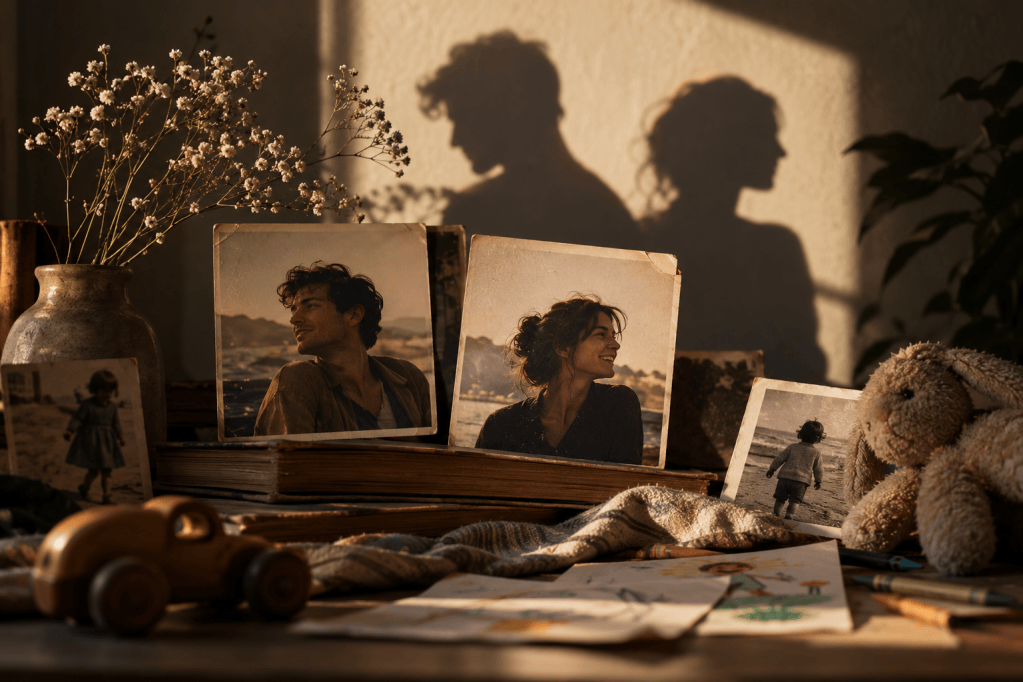
On growing older, understanding our parents, and learning to see
the people behind the roles.
When I was little, I spent a lot of time waiting for my mother to
come home.
I went to school, played, entertained myself, and did all the things
children do. But somewhere in the back of my mind, I was always waiting
for her.
I wanted to tell her about my day. I wanted her attention. I wanted
to be around her.
And sometimes, when she finally came home, she was tired.
She didn’t want noise. Sometimes she was in a bad mood. Sometimes her
answers were shorter than I expected, or she simply didn’t have the
energy I wanted her to have.
As a child, I didn’t understand that.
I had spent the whole day waiting for her. Why wasn’t she as excited
to see me as I was to see her?
Sometimes I wondered if she was annoyed with me.
What I didn’t understand was that my mother had been living
an entire day before walking through our front door.
And I knew almost nothing about it.
I didn’t know how people treated her at work. I didn’t know what
worried her financially, what was happening in her relationships, what
problems existed within the family, or what she might have been feeling
emotionally.
I only knew that she was my mother.
And somehow, in my little world, that was supposed to be enough.
The People We Expect Our
Parents to Be
Over the past few weeks, I’ve found myself listening to conversations
about complicated relationships between parents and their adult
children.
Mothers and daughters who no longer speak. Fathers and sons carrying
years of resentment. Families who have stopped talking altogether.
Adults who still remember, in remarkable detail, what their parents
said, did, or failed to do when they were children.
Some of these stories involve serious pain. Others involve years of
misunderstandings, disappointment, or expectations that were never
met.
And they made me think about something.
When did we forget that our parents are human
beings?
Not just mothers and fathers.
Human beings.
People with insecurities, financial problems, difficult
relationships, bad habits, emotional struggles, exhaustion, ambitions,
and dreams that may have had nothing to do with raising children.
People who sometimes didn’t know what they were doing.
Just like us.
I’m almost 35 years old. I don’t have children, and sometimes I can
barely manage everything happening in my own life.
There are days when work is overwhelming. Days when someone treats me
badly and I struggle not to lose my temper. Days when I’m worried about
money, exhausted, disappointed, or simply not in the mood to talk to
anyone.
Sometimes I don’t even understand my own reactions.
And I’m only responsible for myself.
Now imagine experiencing all of that while raising another human
being.
Or several.
While trying to maintain a relationship. Or dealing with the absence
of one.
While paying bills, working, managing family problems, and attempting
to remain emotionally available to a child who has no idea what you’ve
been through that day.
Becoming a parent doesn’t mean you’ve finished becoming a
person.
Yet sometimes we expect exactly that.
Mum, How Did You Do It?
I think my perspective began to change when I moved to Ireland.
Suddenly, I was experiencing situations that had always existed in
the adult world but that I had never fully understood.
Difficult bosses. Unfair treatment. Financial pressure. Exhaustion.
Complicated relationships. The constant responsibility of figuring
things out.
I remember telling my mother about an argument with a boss.
I was furious.
Who did he think he was? Why was he speaking to me like that? Why
should I tolerate someone treating me that way?
And my mother would listen and say something like:
“I understand, darling. That happened to me too.”
And suddenly, I had questions.
What happened to you? What did you do? How did you manage not to lose
your temper?
Did people treat you like that when you worked at the café?
What about that relationship you were in? How did you deal with
someone who didn’t even make the effort to take you out?
I started asking questions I had never thought to ask before.
And I began to realize how much of my mother’s life I had never
seen.
All those years, I had been living beside a woman whose experiences,
worries, and emotional world I barely understood.
Not because she didn’t have them.
But because I had never really looked.
When I was younger, I thought that because I was a good daughter,
because I studied hard and didn’t cause trouble, my mother shouldn’t
have had much to worry about.
As if being a good child somehow protected a parent from everything
else life could throw at them.
I remember getting excellent grades and expecting a celebration.
Where was the excitement? Where was the party I deserved?
I wanted her to be as thrilled as I was.
And perhaps she was proud. Perhaps she was happy. But perhaps she was
also tired, worried, distracted, or dealing with something I knew
nothing about.
I was measuring her reactions against my expectations without
considering what she might have been carrying.
I knew what I needed from her.
I rarely wondered what she needed.
The Memories We Carry Into
Adulthood
There’s something else I’ve been thinking about.
Many of us carry memories from childhood or adolescence that still
shape the way we see our parents.
We remember the arguments. The disappointments. The moments when we
felt ignored, misunderstood, or hurt.
And those feelings were real.
A child who watches their parents fight doesn’t necessarily
understand the complexities of a marriage. A teenager who sees one
parent mistreat the other may carry that image for years.
And some things are genuinely wrong, regardless of the
circumstances.
But as adults, we begin to understand how complicated life can
be.
We discover that relationships are not always what they appear to be
from the outside.
That a job that looks wonderful can make someone miserable.
That people struggle with their character, their habits, their
addictions, their fears, and their emotional limitations.
That even when we know what the right thing to do is, we don’t always
manage to do it.
And I wonder whether growing older gives us an opportunity to revisit
some of our memories with a wider perspective.
Not to deny what happened.
Not to tell ourselves that something painful was acceptable.
But to recognize that the child who experienced those moments
couldn’t possibly understand everything the adult might understand
today.
The memory may belong to our childhood. But we don’t have to
examine it only through the eyes of the child we once were.
Sometimes understanding more changes how we feel.
Sometimes it doesn’t.
Both are possible.
Understanding Isn’t the
Same as Excusing
I want to be clear about something.
I don’t believe every parent-child relationship needs to be
repaired.
Some people have experienced neglect, abuse, abandonment, or repeated
harm. Some have made the difficult decision to distance themselves from
their families, and that distance may be necessary.
Understanding that our parents are human doesn’t mean excusing
harmful behavior.
Being overwhelmed doesn’t make cruelty acceptable. Having a difficult
childhood doesn’t remove the responsibility to treat others with
care.
And forgiveness, when it happens, is personal. It cannot be
demanded.
But I do believe that understanding can sometimes offer a different
kind of freedom.
The freedom to stop expecting someone to have been a person they
never knew how to be.
The freedom to acknowledge that our parents had limitations without
making those limitations the entire story of our lives.
The freedom to decide what kind of relationship we want today,
whether that means reconnecting, maintaining distance, or simply making
peace with what we cannot change.
And perhaps, for those who are parents themselves, the opportunity to
recognize which patterns they want to carry forward and which ones they
want to change.
Because understanding our parents doesn’t require abandoning
ourselves.
It can be part of understanding ourselves better.
They Were Learning Too
We live in a time when information about psychology, trauma,
emotional intelligence, relationships, and parenting is more accessible
than ever.
We can read books, listen to podcasts, attend therapy, and learn
about patterns that previous generations may never have had the language
to describe.
And still, we struggle.
We repeat behaviors we promised ourselves we’d change.
We lose patience.
We make choices we later regret.
We know what we should do and sometimes fail to do it anyway.
So I find myself wondering how much harder some things must have been
for people who had fewer resources, fewer conversations, and perhaps
very little emotional support.
Again, that doesn’t mean everything they did was right.
It means they were people trying to navigate life with whatever
understanding and tools they had at the time.
And parenthood didn’t magically give them all the answers.
While we were learning how to be children, they were learning how to
be parents.
Neither of us had done it before.
Seeing My Mother Differently
Today, when I think about my mother, I feel an enormous amount of
gratitude.
Not because she was perfect.
But because I can now recognize things I couldn’t see when I was
younger.
I think about how much she worked. How much responsibility she
carried. How many difficult days she must have experienced without me
ever knowing.
I think about the woman who came home exhausted to a little girl who
had spent the entire day waiting for her.
And I see both of them differently now.
I still see that little girl who wanted more attention, more
enthusiasm, more time.
But I also see the woman who had been working all day and was doing
her best to get through it.
And I have so much more compassion for both of them.
Growing older has given me something I didn’t have as a child:
perspective.
I can ask my mother about her life now. I can listen to her stories,
understand her frustrations, laugh about things we once argued over, and
recognize the effort behind moments I used to take for granted.
I can appreciate her not only for what she has done for me, but for
who she is.
A woman with her own history.
Her own dreams.
Her own battles.
Her own life.
And perhaps that’s one of the unexpected gifts of becoming an
adult.
Realizing that the people who raised us were never superheroes.
They were human beings.
And some of them were doing extraordinary things while simply trying
to get through an ordinary day.
I spent my childhood waiting for my mother to come home.
It took me becoming an adult to wonder what she was coming
home from.
And today, more than anything, I’m grateful that I still have the
opportunity to ask her.
Happy Mother’s Day, Mum.
And to every mother who has ever come home exhausted, carrying a
world her children couldn’t yet understand.


Leave a Reply