
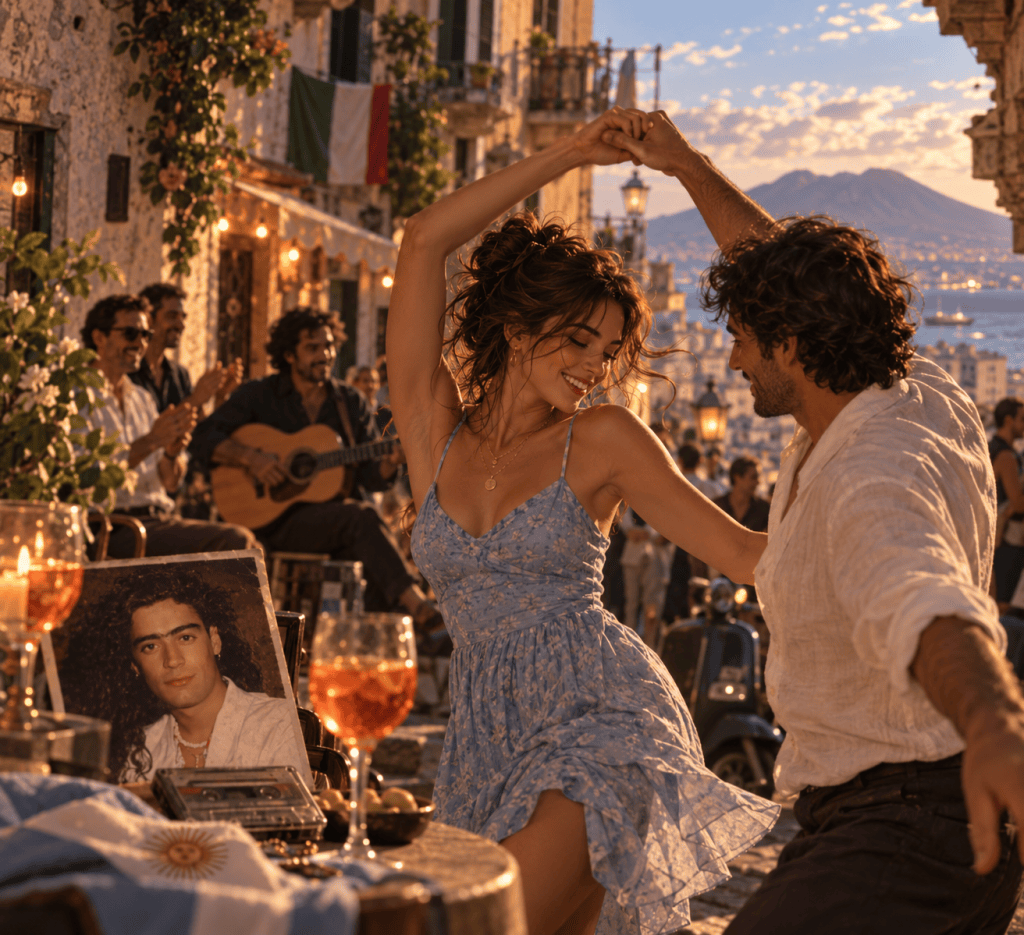
There’s a lot of talk online about romanticizing your life.
Buy yourself flowers.
Drink your coffee from the nice cup.
Walk slowly.
Light a candle.
Put on music while you cook.
Make an ordinary Tuesday feel cinematic.
And I actually like the idea.
But sometimes I think we’ve misunderstood what makes a life feel magical.
Because maybe romanticizing your life isn’t about making everything prettier.
Maybe it’s about paying enough attention to notice when your past and your present unexpectedly meet.
I thought about this recently because of Rodrigo Bueno.
If you’re not Argentine, Rodrigo was a cuarteto singer. He died very young, but for a generation of us, he was much more than a singer.
And for me, he was my first great love.
I was ridiculously young.
Three years old, maybe.
I had his cassette at home and played it constantly. I danced to his songs. I knew the lyrics. As I got older, Rodrigo simply became part of the soundtrack of my childhood.
At one point, I had a poster of him in my bedroom from when he still had his long curls and those green eyes. Next to his picture were the lyrics to Enero a Enero.
I would look at that poster and listen to him sing about being completely, hopelessly in love.
And apparently, so was I.
Then Rodrigo died.
I still remember exactly how I found out.
My mum was working, so I had slept at my friend Antonela’s house. We had played, gone to bed, done whatever little girls do at a sleepover.
The next morning, I woke up before everyone else and went into the kitchen.
The television was on.
And there it was.
Rodrigo Bueno had died.
At first, I thought it was a joke.
I was a child. Death still didn’t entirely make sense to me, especially the death of someone who existed so vividly inside my little world.
But eventually I understood.
I went home later that day, closed the curtains, turned off the light and spent the afternoon lying on my bed crying while staring at my Rodrigo posters.
The love of my life was dead.
And I was devastated.
For years afterwards, I defended him with the absolute irrational loyalty that only a child can have.
Adults would talk about his life, alcohol, drugs, rumours, whatever else people talked about. I didn’t understand any of it.
I just knew they were talking about my Rodrigo, so obviously I was going to defend him.
I bought a book about him.
I had a necklace.
I had a T-shirt.
When the film about his life came out, of course I went to see it. I basically arrived dressed for the occasion in full Rodrigo merchandise and cried my way through the movie.
And then, naturally, life continued.
I grew up.
Rodrigo stopped being the centre of my universe and became something quieter: part of where I came from.
His music followed birthdays, parties, school years, dancing, summers, friends. You didn’t really think about it anymore.
You just heard the first notes of a song and knew exactly what to do.
Years passed.
I left Argentina.
I built a life thousands of kilometres away from the bedroom where those posters used to hang.
And then one day, I was in Naples.
I was walking through the city when someone asked me where I was from.
“Argentina.”
Immediately, his face changed.
Argentina meant Diego Maradona.
And if you’ve ever been to Naples, you know Diego isn’t simply a famous footballer there. He is everywhere.
The man told me something along the lines of:
“We are not Italians. We are Neapolitans. And our hearts are with Argentina.”
I was already amazed by how much affection these people had for my country.
And then something happened that I could never have planned.
He told me he was going to play me Maradona’s song.
And suddenly, in the middle of Naples, I heard Rodrigo Bueno.
La Mano de Dios.
The song Rodrigo had sung about Diego.
The same Rodrigo whose poster I had once had in my childhood bedroom.
The same Diego my grandfather had adored.
The same song connected to a poster I had owned of Rodrigo and Maradona together.
And now I was standing in Naples.
An Argentine woman who had somehow ended up living on the other side of the world.
A Neapolitan man turned the music up in the street and pulled me into a dance.
And there I was.
Dancing cuarteto.
To Rodrigo Bueno.
In Naples.
Because of Diego Maradona.
Thousands of kilometres from home.
I remember being incredibly happy.
Not Instagram happy.
Not “this would make good content” happy.
Just completely, stupidly, genuinely happy.
And when I think about that moment now, I don’t think about how cinematic it looked.
I think about the little girl.
The one with the cassette.
The one staring at Rodrigo’s poster.
The one crying in a dark bedroom because she couldn’t understand how her idol could suddenly disappear.
And I think:
Imagine telling her where we ended up.
Imagine telling her that one day she would leave Argentina.
That she would build a life abroad.
That she would walk through Naples and strangers would celebrate the country she came from.
That someone would put on Rodrigo because she said she was Argentine.
That a Neapolitan man would take her hand and she would dance La Mano de Dios in the street.
She wouldn’t have understood half of it.
But I think she would have been thrilled.
And maybe that’s what romanticizing your life actually is.
Not pretending everything is beautiful.
Not forcing gratitude when you’re having a terrible day.
Not buying flowers and convincing yourself that your problems have disappeared because the vase looks pretty on your kitchen table.
It’s remembering where you came from while you’re standing where you are.
It’s noticing the strange little connections.
The songs that followed you.
The people you once loved.
The things you dreamed about without even knowing they were dreams.
The places you thought were impossibly far away.
The versions of yourself you left behind.
Because when we think about a “fabulous life,” we tend to imagine the obvious things.
The dream job.
The apartment.
The relationship.
The money.
The trip.
The big announcement.
We keep waiting for life to finally become impressive enough for us to appreciate it.
Meanwhile, some of the most extraordinary moments are tiny.
A song playing in the wrong country.
A stranger saying something that reminds you of home.
Eating something your grandmother used to make.
Walking down a street and suddenly remembering who you were at eight.
Realising that something completely ordinary to you now would have been unimaginable to a younger version of yourself.
You don’t have to manufacture those moments.
You just have to notice them.
Maybe that’s the part of “romanticize your life” that gets lost.
It isn’t only about making the present beautiful.
It’s about understanding the whole journey.
Where you came from.
What you carried with you.
What you lost.
What stayed.
Where you are now.
And where you still want to go.
Because sometimes your life has already given you the perfect scene.
You were just too busy waiting for something bigger to realise it.
So maybe today, instead of asking yourself how to make your life more magical, ask yourself something else:
What would the child you used to be find unbelievable about the life you’re living now?


Leave a comment