
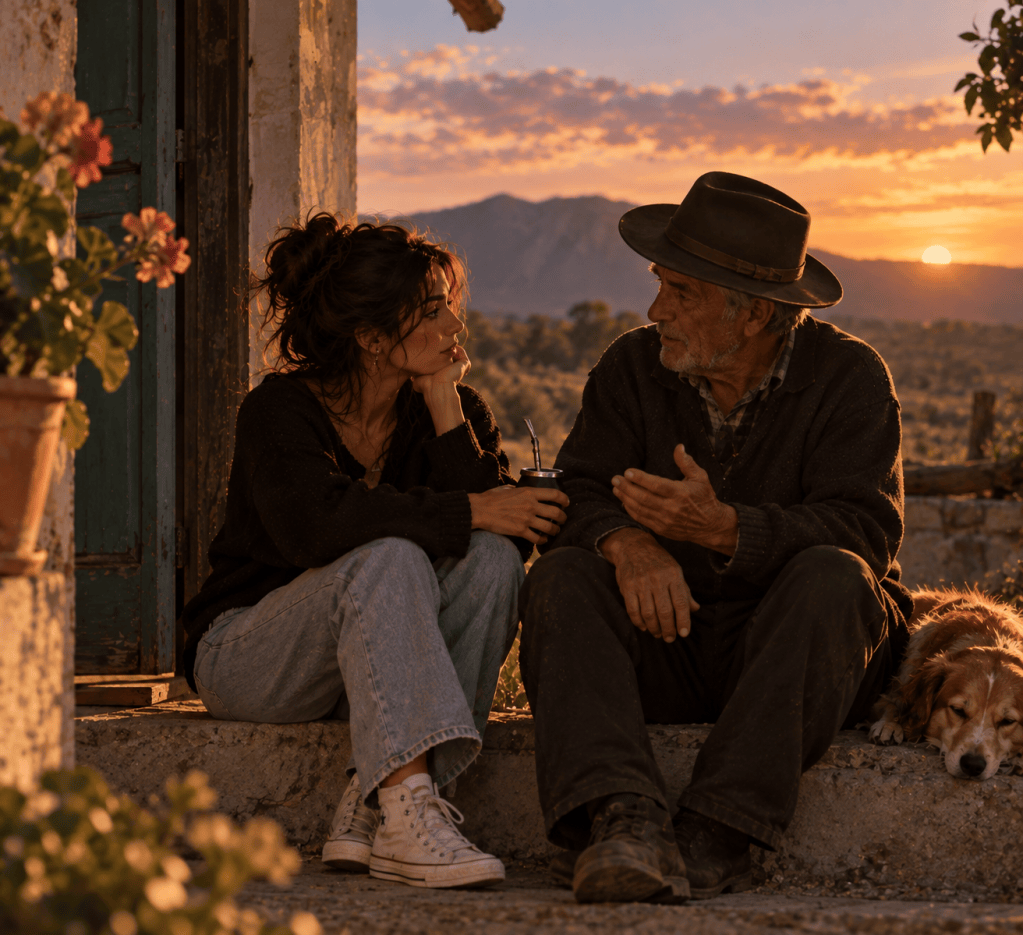
My father left before I was born.
Not when I was five.
Not after a divorce.
Not after a complicated childhood where I had some memories of him and then he disappeared.
Before I was born.
So I grew up as the only daughter of a single mother, with essentially no relationship with my father at all.
For a long time, I thought I understood exactly what that meant.
It meant something was missing.
And, to be fair, something was.
Sometimes, I really did need a dad
As a child, I didn’t necessarily understand my father’s absence in the sophisticated psychological ways I would later learn to explain it.
Some things were much more practical.
There were birthday parties I couldn’t go to because my mum was working and there was nobody to take me and pick me up.
There were things I wanted that my mum couldn’t afford.
There were moments when another adult would simply have made life easier.
As I got older, the absence became less practical and more abstract.
I started imagining all the things a father might have given me.
Confidence.
Advice.
A different relationship with money.
Someone telling me to take the risk.
Someone saying:
Go. Try. You’ll be fine.
Maybe someone slightly less terrified than a single mother who had spent her entire life knowing that if something happened to her daughter, there wasn’t another parent standing behind her.
My mum had to be everything.
The person who provided.
The person who protected.
The person who worried.
The person who made decisions.
The person who worked.
The person who somehow tried to cover every role available with one human body.
And still, one person cannot be two people.
So yes.
There were moments when I needed a dad.
I didn’t have one.
Both things are true.
Then I discovered psychology and found an explanation for everything
As an adult, I started looking at my life differently.
Church.
Psychoanalysis.
Cognitive therapy.
Other ways of understanding behaviour.
Spirituality.
Astrology.
Anything that might help me understand why we become who we become.
And for a while, my father’s absence became a very useful explanation.
Why was this difficult for me?
My father.
Why did I struggle with this?
My father.
Why were relationships with men complicated?
Well, obviously.
My father.
There was something almost comforting about connecting the dots.
Ah.
That’s why.
And some of those connections may be meaningful.
Our childhoods affect us.
The relationships we see affect us.
The relationships we don’t have affect us too.
Understanding those things can be enormously helpful.
But there’s a strange moment that can happen after understanding.
You can discover where a wound came from…
and then accidentally build a house inside it.
First I blamed him. Then I found someone else to blame.
At one point, everything was my father’s fault.
Then, as I kept digging, things became more complicated.
Well, what about my mum?
What about the position she put me in?
What about her fears?
What about her own history?
Because she had one too.
My mum had experienced abandonment herself.
Her father — my grandfather, my tata — had problems with alcohol.
There were times when his drinking would take him away from the family for days.
I lived in his house until I was around four years old.
And because my biological father wasn’t there, my tata was also the closest thing I had to a male parental figure.
Suddenly the family tree became very psychologically convenient.
There were explanations everywhere.
This person did this because that person had done that.
This wound created that behaviour.
That behaviour created another wound.
You can keep going backwards for generations if you want.
And maybe you’ll be right.
But eventually I started wondering:
Okay. Now what?
Having an explanation doesn’t give me permission to stay the same
This is where I think conversations about healing can become uncomfortable.
Because understanding why we behave a certain way is important.
Sometimes incredibly important.
If you understand where something came from, you can finally stop thinking you’re reacting for no reason.
But explanation and permission are different things.
I behave like this because this happened to me.
Okay.
Maybe that’s true.
But then what?
Do I get to behave like this forever?
Do I get to hurt people because someone hurt me?
Do I get to avoid intimacy forever because intimacy once felt unsafe?
Do I get to repeat the same relationship for twenty years because I’ve identified the childhood wound underneath it?
At what point does:
“This explains me”
have to become:
“So what am I going to do with it?”
Therapy helped me understand parts of my story.
But I don’t think the purpose of understanding my story is to become better at defending every version of myself.
I want understanding to give me more choices.
Not fewer.
I learned this from my tata before I had the language for it
I remember something that happened when I was around nineteen.
I’d been away and came back to visit my family.
I went to see my grandfather and my uncles, who lived nearby.
My tata wasn’t there.
Nobody knew exactly where he was.
Eventually, he came home.
Drunk.
I remember the scene clearly.
His son and daughter were furious.
One spoke to him harshly.
The other basically ignored him.
Then they left.
And suddenly I was there alone with him.
I was angry too.
Of course I was.
There’s a very human part of you that looks at someone you love in that condition and thinks:
For fuck’s sake.
You’re supposed to be taking care of me.
You’re the older person.
You’re my grandfather.
You’re supposed to be the one asking whether I’m okay.
Not the other way around.
I felt all of that.
And then I looked at him.
Two of his children had already been angry with him.
And I remember thinking:
I’m not going to be the third.
So I changed my face
I took a breath.
Literally.
I remember changing the expression on my face.
I sat him down.
I gave him water.
Then I made him tea.
He was complaining.
This person was angry with him.
That person had said something.
Nobody understood him.
And instead of joining the anger, I asked:
What happened?
Where were you?
Are you okay?
How was your day?
And eventually I told him something like:
I love you. I came here because I want to see you. I want you to be okay.
Seeing you like this makes me sad.
But I’m not going to treat you badly because I’m sad.
I wasn’t saying:
This is fine.
I wasn’t saying:
Keep drinking.
I wasn’t saying:
Nobody has the right to be angry with you.
I was saying something different.
I don’t understand what you’re doing. But I want to understand you.
And something changed.
That night, my grandfather became a man
Until then, I knew him primarily through his role.
My tata.
My grandfather.
The adult.
The man who was supposed to behave like a grandfather.
That night, he told me things.
Personal things.
Things about his life.
Things that had happened to him from the time he was very young.
Pain I had never known about.
Experiences I had never had.
Things that suddenly made parts of the man sitting in front of me more understandable.
Not correct.
Understandable.
And that distinction matters enormously to me.
Because humanising someone is not the same as absolving them.
Understanding why somebody hurts does not mean volunteering to be hurt by them.
Compassion does not require the absence of boundaries.
But sometimes the role gets in the way of seeing the person.
Father.
Mother.
Grandfather.
Partner.
They are enormous words.
Each comes loaded with expectations.
A father should…
A mother should…
A grandfather should…
A partner should…
And yes.
They should.
There are responsibilities attached to those roles.
But underneath every one of those words is still some confused human being who existed before they became your anything.
They had parents.
Fears.
Humiliations.
Losses.
Things nobody explained to them.
Things they never healed.
Choices they made badly.
Things that happened to them that you may never know.
Their story doesn’t erase yours.
But your story doesn’t erase theirs either.
The child only knows the wound from one side
When you’re a child, you can’t possibly understand all of this.
You shouldn’t have to.
A child experiences what happens.
Someone leaves.
Someone drinks.
Someone screams.
Someone doesn’t show up.
Someone is afraid.
Someone fails to protect you.
And from the child’s perspective, the story is simple:
This happened to me.
Then we grow up carrying that perspective.
Sometimes for decades.
And eventually we learn words for it.
Abandonment.
Attachment.
Trauma.
Neglect.
Family patterns.
And those words can help us enormously.
They can give shape to things we couldn’t explain.
But sometimes I wonder whether we can become so fluent in the language of our wounds that we forget to keep looking.
Because the adult who wounded the child also had a story.
That doesn’t mean the child has to forgive them.
It doesn’t mean reconciliation is always possible.
It definitely doesn’t mean everyone deserves access to your life.
Sometimes distance is the healthiest answer.
But there is a difference between saying:
“What you did affected me.”
and saying:
“What you did gets to determine who I become.”
I don’t know who I would have been with a father
I’ve thought about it.
Of course I have.
Maybe I would have been more confident.
Maybe relationships with men would have been easier.
Maybe someone would have taught me about money.
Maybe I would have taken more risks earlier.
Maybe I would have felt more protected.
Maybe.
But here’s the annoying thing about imaginary lives:
You can make them perfect because they never happened.
The father I imagine isn’t a real person.
He’s an ideal father.
He gives good advice.
He picks me up from birthday parties.
He teaches me confidence.
He helps financially.
He encourages me.
He is emotionally available.
Conveniently, my imaginary father has no annoying habits, unresolved trauma, financial problems, bad moods or questionable opinions.
He’s excellent.
Because I invented him.
The alternative life gets all the advantages and none of the consequences.
But I have no idea who I would be if my father had stayed.
Maybe some things would have been easier.
Maybe some things would have been harder.
Maybe I’d be happier.
Maybe I wouldn’t.
I don’t know.
That woman doesn’t exist.
I do.
And I actually like the woman who exists
This is the part that changed everything for me.
If I could alter my past, I wouldn’t simply be removing painful experiences.
I’d be changing the entire chain of events that produced me.
My relationship with my mum would be different.
My independence might be different.
The way I love might be different.
My sensitivity.
My ambition.
My fears.
My values.
The things I notice about people.
The things I refuse to repeat.
The things I had to teach myself.
I don’t know which pieces would survive the edit.
And today, I’m proud of who I am.
That doesn’t mean I’m grateful my father left.
Those are not the same sentence.
I don’t have to be grateful for what hurt me in order to value who I became afterwards.
That’s much closer to what I believe.
Maybe the question isn’t whether it should have happened
I’ve heard people who grew up with difficult fathers say:
Honestly, I would’ve been better off without one.
And I’ve thought:
Maybe.
Maybe not.
Because they’re doing the same impossible calculation I used to do.
Removing one person from the past while keeping everything they like about the present.
But lives don’t work like that.
You can’t pull one thread out and know exactly which parts of the fabric would remain.
Maybe you would have suffered less.
Maybe you would have suffered differently.
We simply don’t know.
And I think there can be freedom in finally admitting that.
Because then I don’t have to spend my life negotiating with an alternative universe.
If only he had…
If only she hadn’t…
If my childhood had…
There is no answer waiting at the end of those sentences.
There’s only the life that happened.
And the life I have now.
Look in the fridge
Maybe this sounds ridiculous after talking about fathers, abandonment, alcoholism and generational wounds.
But I keep thinking about a fridge.
Imagine opening it and saying:
There’s nothing to eat.
You wanted meat and potatoes.
Easy.
Obvious.
You know exactly what dinner would have looked like.
Except there isn’t any meat.
There aren’t any potatoes.
So you can stand there furious about the dinner you can’t make.
And maybe you have every right to be annoyed.
Or eventually, you can actually look.
There’s an onion.
Some rice.
Two eggs.
A tomato.
Something weird in a jar.
Okay.
What can I make with this?
Not:
This is exactly what I wanted.
Not:
I’m so grateful there are no potatoes.
Just:
This is what I have. What can I build from here?
And maybe you make something you’d never have made otherwise.
Maybe it’s incredible.
Maybe it’s mediocre and tomorrow you try again.
But at least you’re cooking.
I don’t want my wound to become my biography
My father wasn’t there.
That matters.
My grandfather struggled with alcohol.
That matters.
My mother had her own history and fears.
That matters.
Things happened in my family that shaped me.
That matters.
But none of those sentences can tell you who I have to be next.
I think there comes a moment when healing has to become more than understanding why the house looks the way it does.
At some point, if I’m going to keep living here, I have to decide what I’m renovating.
What stays.
What goes.
What I repair.
What I refuse to reproduce.
What I build that nobody before me knew how to build.
Maybe that’s evolution.
Not pretending the wound never happened.
Not forgiving everyone because spirituality told you to.
Not turning pain into some beautiful destiny it never asked to be.
Just refusing to spend the rest of your life giving the past a job it no longer needs to have.
I can say:
I needed a father.
And:
I didn’t have one.
And:
That affected me.
And:
I am still responsible for what I do with my life now.
All four can be true.
Maybe that’s the part I’ve been trying to understand all these years.
I don’t need a different childhood to justify building a different adulthood.
I don’t need to hate the people who couldn’t give me what I needed.
I don’t even need to completely understand them.
But I also don’t have to become the permanent narrator of everything they did wrong.
At some point, I want to tell the rest of the story.
The part where I got the ingredients I got.
Looked at them.
Learned.
Changed.
Built.
Loved.
Fucked things up.
Tried again.
And made something that was mine.
What if healing isn’t finally finding someone to blame for who you became — but realising you get to decide who you become next?


Leave a comment